

HTL Workforce Academy
- Programs
- Admissions
- Funding
- Student Resources
- About Us
- …
- Programs
- Admissions
- Funding
- Student Resources
- About Us
HTL Workforce Academy
- Programs
- Admissions
- Funding
- Student Resources
- About Us
- …
- Programs
- Admissions
- Funding
- Student Resources
- About Us
Strategic Operations & Management Analysis
TURN ORGANIZATIONAL PROBLEMS INTO STRATEGIC SOLUTIONS.
This 10-week hybrid certificate program prepares learners to analyze organizational systems, identify operational challenges, improve workflows, and develop strategic recommendations.
Length
10 Weeks
Format
Hybrid
Location
West End Campus + HTL LMS
Credential
Certificate
Clock Hours
100
Instructor
TBA
What you will learn
Students develop skills in:
- Systems thinking
- Workflow analysis
- Organizational diagnostics
- Data gathering
- Strategic planning
- Root-cause analysis
- Communication
- Conflict resolution
- Leadership
- Change management
- Documentation
- Business technology
- Career development
How you will learn
1Learn
2Practice
3Apply
4Present
Students participate in:
- Instructor-led instruction
- Laboratory exercises
- Case studies
- Simulations
- Discussions
- Projects
- Technology labs
- Capstone activities
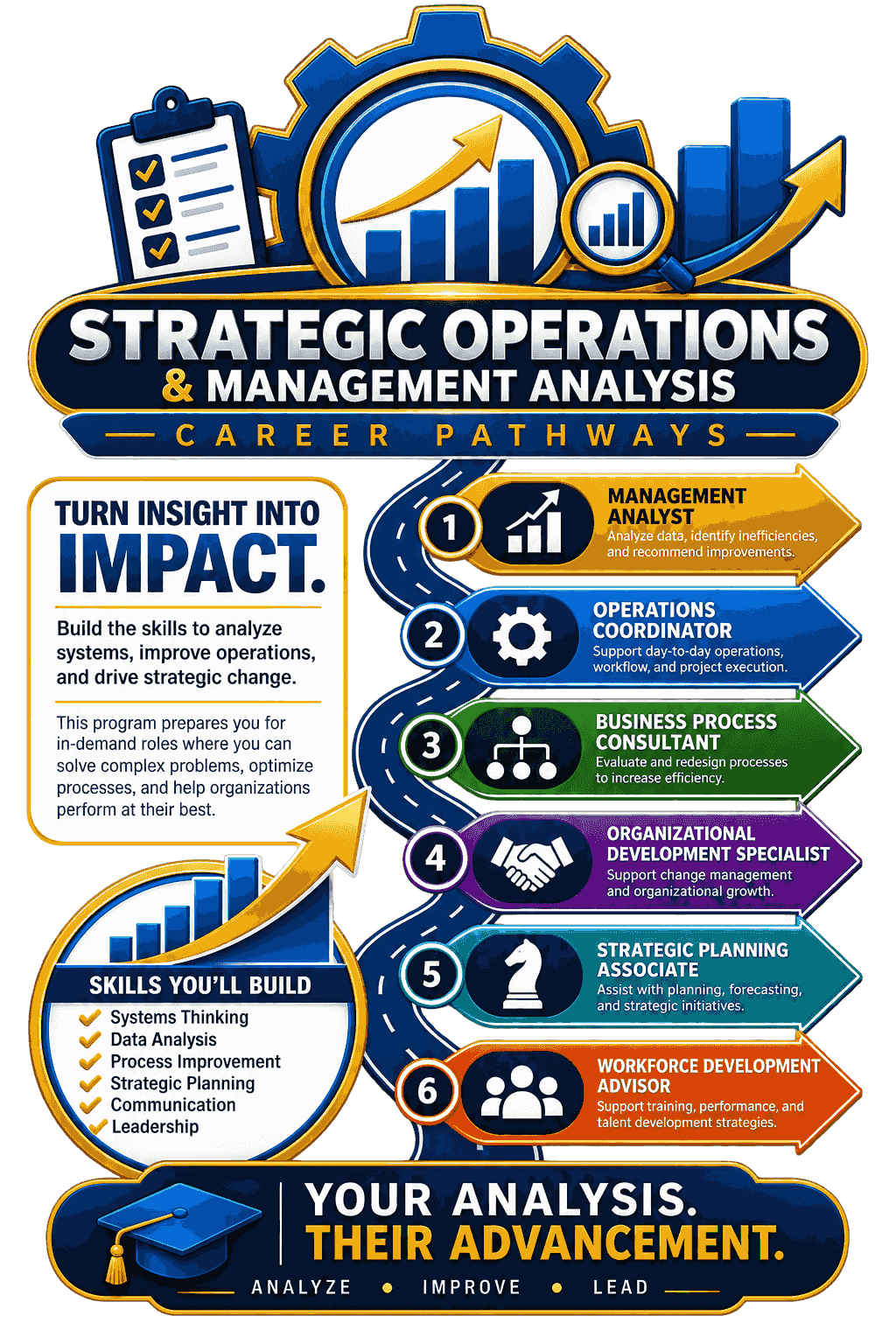
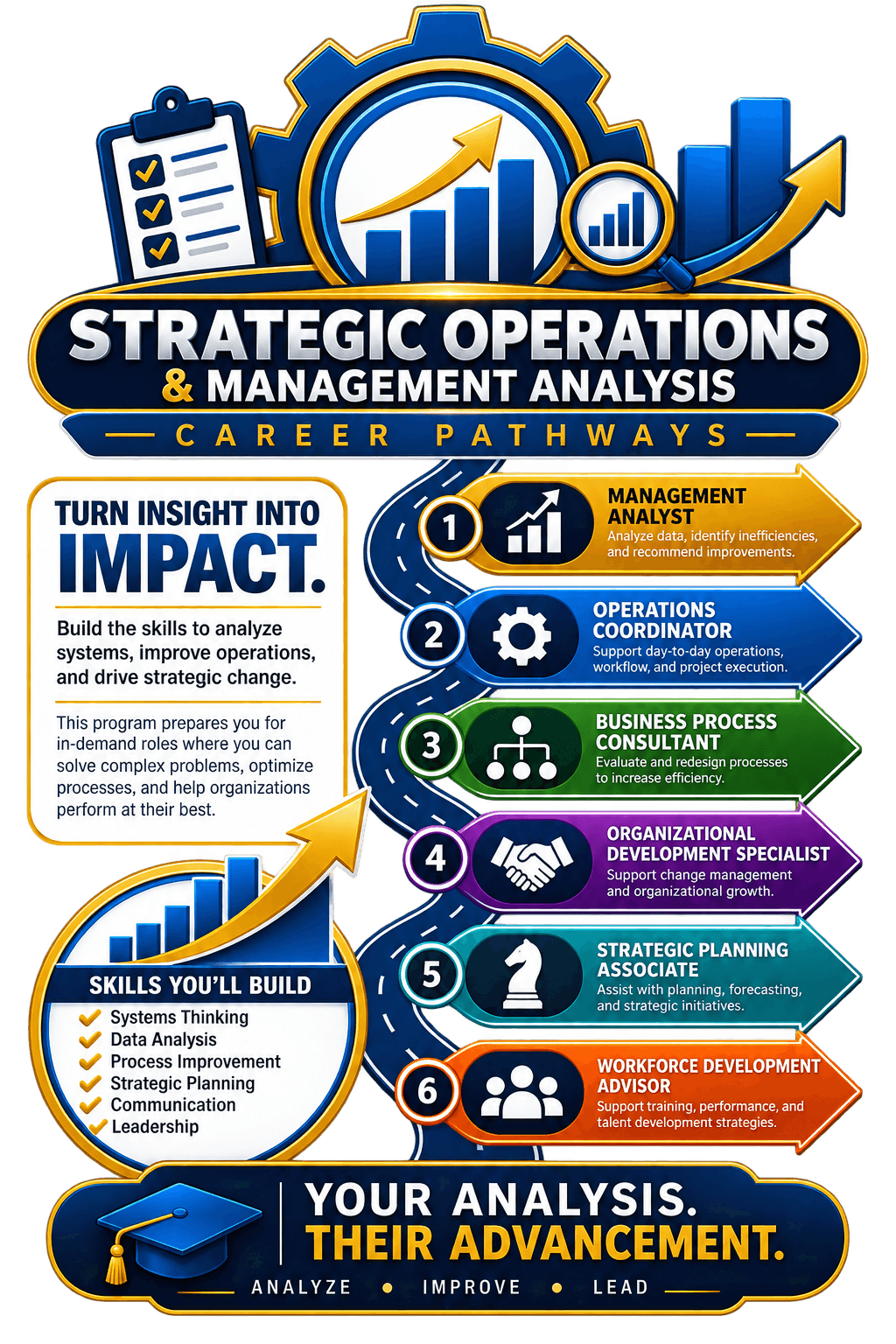
Career Pathways
Program Curriculum
Week 1 — Introduction to Management Analysis & Systems Thinking
Module Focus
Students are introduced to the role of the Management Analyst and the concept of systems thinking. The module examines how people, processes, tools, information, and decisions interact to produce organizational outcomes.
Objectives
Students will:
- Define the role of a Management Analyst.
- Explain the principles of systems thinking.
- Identify the components of an organizational system.
- Recognize patterns, bottlenecks, and system-level problems.
- Student Outcomes
By the end of the module, students will be able to look beyond individual problems and identify how organizational structures, processes, and relationships contribute to workplace outcomes.
Week 2 — Workflow Analysis & Organizational Diagnostics
Module Focus
Students move from understanding systems to examining howwork actually flows through an organization. They learn to use workflow maps and visual tools to identify delays, bottlenecks, duplication, and unclear responsibilities.
Objectives
Students will:- Analyze organizational workflows.
- Create basic workflow and swimlane diagrams.
- Identify process inefficiencies and bottlenecks.
- Examine roles, handoffs, and decision points.
- Develop preliminary process-improvement recommendations.
Student Outcomes
Students will be able to map a workplace process,identify where breakdowns occur, and recommend practical improvements based on
their analysis.Week 3 — Data Gathering, Interviewing & Observation
Module Focus
Students learn how Management Analysts gather informationbefore making recommendations. Emphasis is placed on stakeholder interviews, observation, active listening, questioning techniques, and qualitative data collection.
Objectives
Students will:- Develop effective interview questions.
- Conduct stakeholder interviews.
- Create observation protocols.
- Practice active listening.
- Identify themes and patterns in qualitative information.
- Student Outcomes
Students will be able to gather reliable information fromstakeholders and observations while maintaining objectivity and avoiding
premature conclusions.Week 4 — Communication, Conflict Resolution & DISC Assessment
Module Focus
Students explore communication styles, behavioraldifferences, workplace conflict, and stakeholder relationships. The DISC framework is used to help students understand behavioral tendencies and adapt their communication approach.Objectives
Students will:
- Identify communication and behavioral styles.
- Apply DISC concepts to workplace interactions.
- Recognize sources of workplace conflict.
- Apply principles of effective difficult conversations.
- Develop strategies for building stakeholder trust.
Student Outcomes
Students will be able to adapt communicationstrategies, navigate workplace conflict, and communicate more effectively with
individuals who have different behavioral styles.Week 5 — Strategic Planning & Problem Solving
Module Focus
Students learn to move from identifying problems to developing strategic solutions. The module introduces root-cause analysis tools, including the Fishbone Diagram and 5 Whys, along with SMART goal development and strategic prioritization.
Objectives
Students will:
Distinguish symptoms from root causes.
- Apply structured problem-solving techniques.
- Use Fishbone and 5 Whys analysis.
- Develop SMART goals.
- Connect solutions to organizational outcomes.
Student Outcomes
Students will be able to diagnose organizational problems, identify root causes, and develop measurable goals and recommendations that address underlying issues.
Week 6 — Motivation & Organizational Change
Module Focus
Students examine the relationship between employee motivation and organizational change. The module explores how autonomy, mastery, purpose, leadership, and organizational culture can influence employee engagement and change outcomes.
Objectives
Students will:
- Explain key concepts of workplace motivation.
- Identify factors that influence employee engagement.
- Examine resistance to organizational change.
- Develop strategies for supporting change.
- Connect motivation to organizational performance.
Student Outcomes
Students will be able to analyze motivational factors and develop change strategies that encourage employee engagement, participation, and organizational improvement.
Week 7 — Documentation, Reporting & Records Management
Module Focus
Students learn how effective documentation supports communication, accountability, decision-making, and continuous improvement. Students are introduced to structured reporting and A3 problem-solving documentation.
Objectives
Students will:
- Explain the purpose of effective organizational documentation.
- Create clear and concise reports.
- Apply A3 reporting principles.
- Evaluate existing documentation systems.
- Identify opportunities to improve records and information management.
Student Outcomes
Students will be able to produce professional operational documentation and evaluate existing records for clarity, usability, accuracy, and effectiveness..
Week 8 — Leadership, Coaching & Influence
Module Focus
Students examine leadership as a process of influence rather than simply a position of authority. The module focuses on leadership styles, self-awareness, coaching, mentoring, trust, and influencing organizational outcomes.
Objectives
Students will:
- Identify personal leadership strengths and development areas.
- Examine different leadership approaches.
- Practice coaching and mentoring techniques.
- Apply leadership principles to workplace challenges.
- Develop strategies for influencing others without relying solely on authority.
Student Outcomes
Students will be able to demonstrate leadership behaviors, conduct effective coaching conversations, and use influence to support individuals, teams, and organizational goals.
Week 9 — Software Tools for Management Analysts
Module Focus
Students develop practical technology skills used to organize, analyze, document, and communicate organizational information. Instruction includes Microsoft Excel, document management, digital collaboration, and introductory ERP/MRP concepts.
Objectives
Students will:
- Use Excel for basic data analysis and reporting.
- Develop spreadsheets and dashboards.
- Organize and manage digital documents.
- Use collaborative digital tools.
- Explain the role of ERP/MRP systems in organizational operations.
Student Outcomes
Students will be able to use common business technology tools to organize information, analyze data, prepare reports, and support operational decision-making.
Week 10 — Capstone Project & Career Preparation
Module Focus
The final module integrates the knowledge and skills developed throughout the course. Students complete and present a capstone project demonstrating their ability to analyze an organizational problem, identify root causes, and develop a strategic improvement recommendation. Career preparation activities support transition into employment.
Objectives
Students will:
- Integrate systems-thinking and analytical skills.
- Apply workflow and problem-solving techniques.
- Develop a strategic organizational recommendation.
- Present findings professionally.
- Prepare a professional resume and career portfolio.
- Practice interviewing and employment communication.
Student Outcomes
By the end of the module, students will be able to demonstrate their readiness to apply management-analysis skills in a professional environment through a completed capstone project, professional portfolio, and career transition plan.
Program Cost
Tuition: $4,950
Application Fee: $150
Technology/LMS Fee: $200
Books & Instructional Materials: $325
Career & Capstone Support: $175
Externship Placement: $200
Total Program Cost: $5,875Unlock Your Potential with HTL Workforce Academy
Empower Your Future
©2026 - HTL Workforce Education and Training Center